About Julian Chambliss
As an interdisciplinary teacher and scholar concerned with real and imagined spaces, I integrate a historical understanding into investigations of contemporary culture.
My work is framed around a central question: What does it mean to be a scholar in the twentieth-first century? Informed by a community engagement framework that emphasizes the Classroom as Platform, I pursue a public humanities practice that supports student learning and community action.
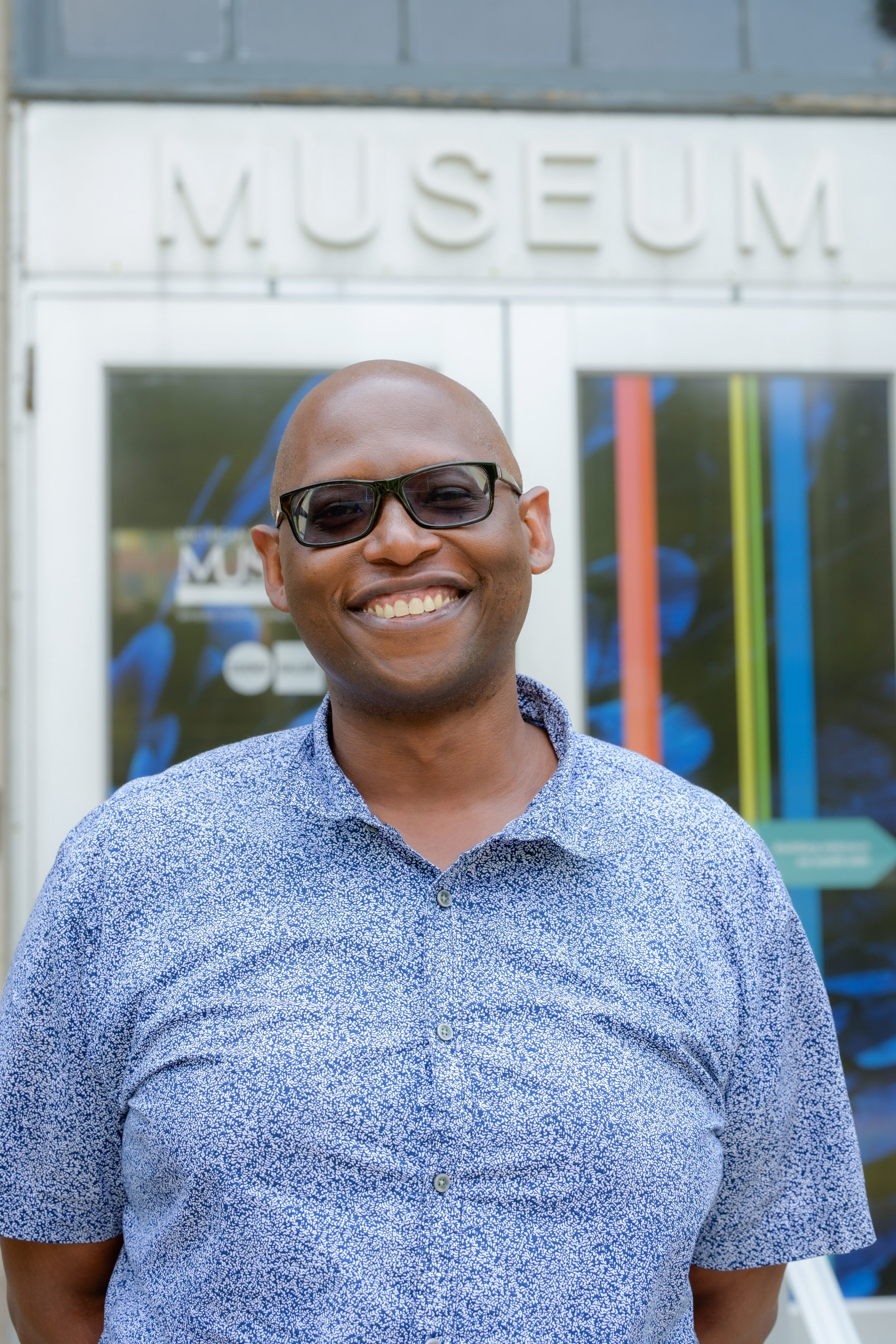
Chambliss is an interdisciplinary scholar whose work brings together Black Digital Humanities, Critical Afrofuturism, Cultural Studies, and public history to examine how communities imagine, build, and contest the worlds they inhabit. Across research, teaching, curatorial practice, and public engagement, his work explores real and imagined spaces: cities, archives, museums, comics, sound cultures, speculative futures, and the digital systems that shape how culture is preserved and interpreted.
Like most Floridians, Julian was not born in the state. His true origin remains shrouded in mystery. What is known is that a quiet demeanor, deep curiosity, and a glowing character guided him through childhood. Once freed from high school, he began his undergraduate education at Jacksonville University, where an early inability to pick a major eventually gave way to a lasting commitment to history. Through the Ronald E. McNair Post Baccalaureate Program, he discovered that historical inquiry could be both intellectually stimulating and publicly meaningful. After completing his undergraduate work with honors in history, he attended the University of Florida, where he focused on urban history, policy formation, regionalism, civic infrastructure, and the cultural forces that shape collective life.
From 2004 to 2018, Chambliss served as Professor of History in the Department of History at Rollins College. His work there deepened his commitment to community engagement, public history, and student-centered research. He was recognized for this work with the Rollins College Cornell Distinguished Service Award and the Florida Campus Compact Service Learning Faculty Award. In 2018, he joined the Department of English at Michigan State University, where his scholarship increasingly centered comics, popular culture, digital humanities, and speculative practice as tools for understanding race, identity, and power.
Since 2020, Dr. Chambliss’s work has expanded across several interconnected areas. He serves as Professor of English and the Val Berryman Curator of History at the MSU Museum, where he develops projects that activate archives, material culture, and public memory. He is co-director of the Digital Humanities and Literary Cognition Lab and faculty lead for the Graphic Possibilities Comic Research Workshop. His recent work explores comics as data, Black speculative practice, Afrofuturism, urban imaginaries, and the use of digital tools to recover, visualize, and interpret cultural histories.
Chambliss’s recent scholarship and public-facing projects reflect this evolution. His work on Afrofuturism includes Mapping Afrofuturism: Understanding Black Speculative Practice and the PBS documentary Afrofantastic: The Transformative World of Afrofuturism. His comics scholarship examines how graphic narratives shape ideas about race, identity, urban space, and popular memory. His digital humanities practice uses collaborative research, metadata, visualization, and public scholarship to ask how archives can be made more inclusive, dynamic, and accountable.
As a teacher-scholar concerned with community, identity, and power, Dr. Chambliss designs generative digital projects that use the classroom as a site of collaborative inquiry. His courses invite students to act as co-researchers by tracing cultural histories, documenting underrepresented experiences, analyzing comics and sound cultures, and experimenting with digital methods. Across these projects, he treats teaching as a form of public humanities practice, one that connects scholarly interpretation to community knowledge, creative production, and shared cultural memory.
Dr. Chambliss has also continued to shape national and international conversations about comics studies, digital humanities, Afrofuturism, and public culture. He has served in leadership roles with organizations including HASTAC, the Zora Neale Hurston Festival of the Arts and Humanities, the Society for American City and Regional Planning History (SACRPH), and the Comics Studies Society. Across these commitments, his work asks how cultural practice helps communities imagine freedom, remember struggle, and build more just futures.
 orcid.org/0000-0003-2779-048X