TEACHING
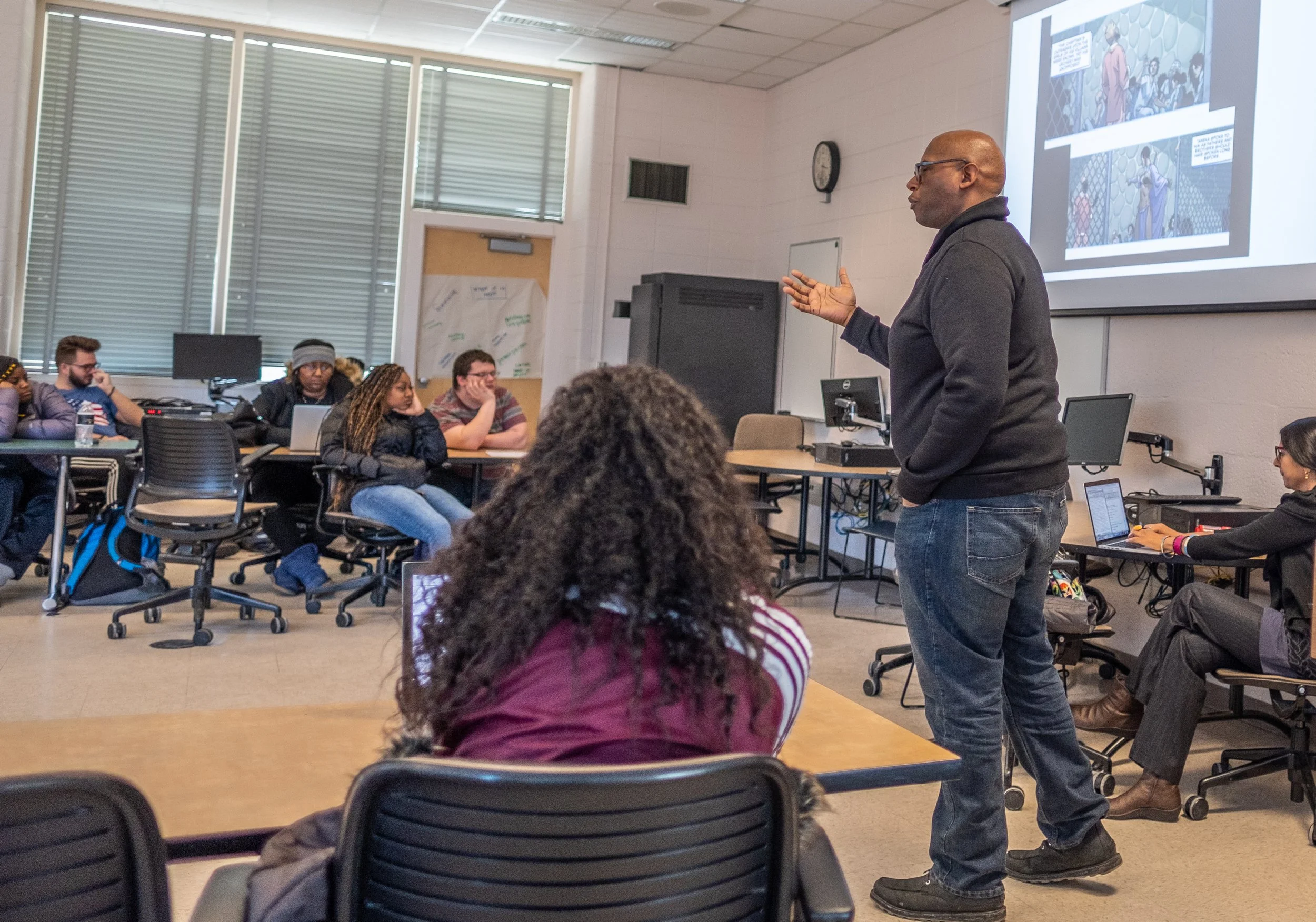
I have developed a pedagogical approach that relies on creating a synergy between theory and practice that engages the community through archival research and the use of digital tools.
COURSES
AfroFantastic: Race, Gender, and Power in the Black Imaginary
Since the 1990s we have seen an explosion of speculative art rooted in the black diasporic experience. Spanning media and crossing borders, the speculative work offered by these voices has coalesced into a movement broadly defined as Afrofuturism. This course examines the historical roots and contemporary expression of Afrofuturism in the United States.
Literature and Visual Culture
Mixing critical inquiry and making, this course examines literature, culture and society through the lens of popular culture.
Readings in Graphic Narratives
This course introduces students to the history, form, and cultural significance of comics and graphic narratives. From early newspaper strips to contemporary graphic novels, superhero sagas, Afrofuturist visions, and global traditions, students examine how comics both reflect and shape ideas of identity, power, and community.
Open Access
Foundations of Literature through Graphic Narratives
An open-access online resource that supports the use of comics in the classroom to teach literary theory.
Graphic Possibilities Comic Research Guide
In collaboration with the MSU Library, this resource guide provides a foundation for people interested in studying, teaching, and contributing to comics and comics-based scholarship in the classroom.
ENGAGED TEACHING
My teaching engages race, identity, and community in the United States. I am now especially focused on how the digital humanities can highlight ways of knowing and being that document institution-building and an empowered imaginary. I collaborate with my students on critical making projects rooted in questions of community, identity and power.
Critical Making can be described as a process of material exploration and creation to promote understanding. By making objects linked to culture, the maker gains understanding about the subject. Critical Making is often associated with design and engineering education, but increasingly, these activities are being incorporated into the humanities and social sciences due to the abundance of digital tools available to faculty and students.
Traditionally, I describe this process in my courses as a series of scaled cognitive exercises. Meaning, these projects require my students to start an endeavor by exploring materials linked to a problem and then analyzing and using that material to create a project using digital methodologies that clarify critical concerns. I see digital space as a natural arena to engage the wider community in a public humanities practice that supports greater understanding about society. Whether within the structure of classes or in the context of guided research projects, my goal is to document the ideas that shape culture in the United States.